That “Last of Yesterday” Quote by Helmut Sündermann
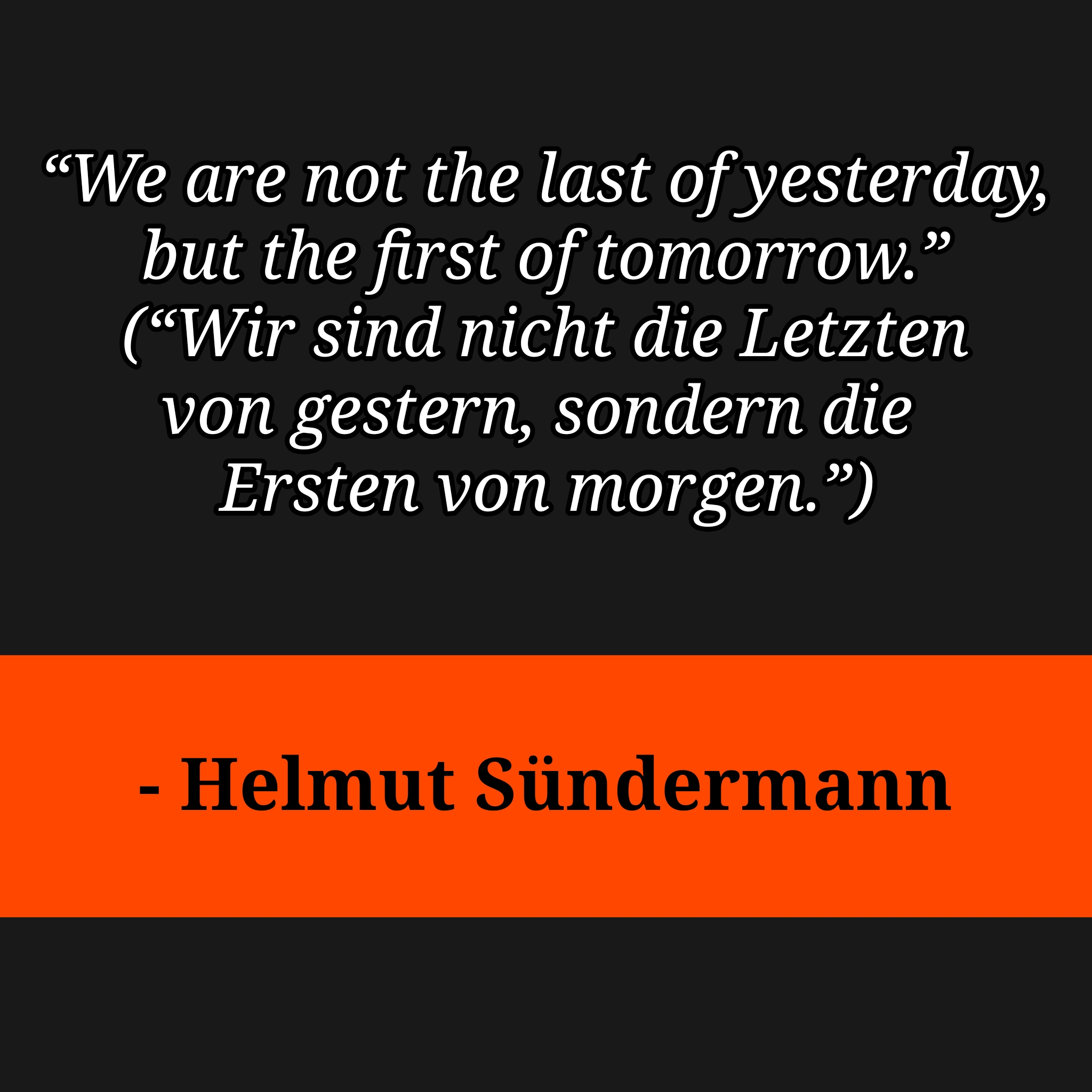
The quote “We are not the last of yesterday, but the first of tomorrow.” (Wir sind nicht die Letzten von gestern, sondern die Ersten von morgen) is famously attributed to Deputy Reich Press Chief, Helmut Sündermann ( ᛉ February 19th 1911 – ᛣ August 25th 1972) who operated in that position under Otto Dietrich during the Nationalsocialist Third Reich.
However, I can find no record of him ever saying or writing such words. That isn’t to say he didn’t, just that their doesn’t appear to be any record of it. So as it stands it cannot be accurately said that it is a quote that can be applied to him.
When you do search for the quote, and what it is most commonly known to come from is Matthias Koehl‘s ‘Faith of the Future‘ (originally published in The National Socialist, issue four (Spring 1982), under the title “Hitlerism: Faith of the Future.” A second revised edition appeared in 1995. Audio version December 13th 2025). Their is no source given for the quote in this book of his, just “H. Sündermann”. At present, I am unsure whether the attributed quote appeared in the original 1982 edition or the revised 1995 version.
However, the oldest reference to this quote, or one extremely similar, dates back to 1978 in an article in Der Spiegel from June 11th 1978, specifically in an invitation issued by Alfredo Winkelmann, Chairman, Deutschvölkische Gemeinschaft (DVG), from Itatiaia, Brazil and owner of the Tyll hotel, along with his wife, Adalgisa Winkelmann. The invitation was issued by Alfredo to former SS members and sympathisers to attend a meeting.
The invitation reads in full as below, the specific quote in bold:
“Geehrter Freund! Hiermit laden wir Sie ein — so wie voriges Jahr — zum Treffen der Freunde des 20. April am 20. April hier zu erscheinen. Wir erwarten Gäste aus aller Welt. Wir werden viel Zeit und Ruhe haben, um gemütlich zusammen zu sein Das große Mittagessen wird am Sonnabend, dem 22. April, hier im Hotel »Tyll« stattfinden. Wir werden auch Erklärungen von anderen Freundeskreisen hören, welche wie wir nicht die Letzten von gestern, aber die Ersten von morgen sein wollen — vielleicht aber auch die Ersten von heute auf dem Wege für eine gerechtere, kraftvollere Zukunft unseres Volkes. Mit einem herzlichen Ahoi, Alfredo Winkelmann.” (Source)
Later in 1987, five years after the original publication of Faith of the Future, and eight years before the second revised edition, a very close version of the quote is said by Uelzen Nationalsocialist Hans Herbert Meyer (ᛉ October 21st 1941 – ᛣ March 15th 2024 (obituary notice 1 and 2)). This came in an obituary notice (Traueranzeige) written by Meyer shortly after the death of Rudolf Heß on August 17th 1987 and appeared in the Uelzener Anzeiger newspaper. Whilst no original document appears online of this orituary notice, it has been released in part in the Antifaschistisches Infoblatt (AIB), Issue Nr. 2, December 1987, the earliest published reference reproducing the text of the notice.
The text reads as below, the specific quote in bold:
“Der Mann, der durch den historischen Flug nach England sein Leben für den Frieden einsetzte, Rudolf Heß, hat seinen Kampf für Deutschland bis zum bitteren Ende bestanden.“ und weiter: „Wir werden ihm das Denkmal setzen, das seine Feinde ihm verwehren wollen. Wir sind vielleicht die letzten von gestern, aber wir sind auch die ersten von morgen.” (Source)
The Amadeu Antonio Foundation (Stiftung) report (on ethnic right-wing extremism in Lower Saxony (völkischer Rechtsextremismus in Niedersachsen), PDF from 2018, references the 1987 notice here.) See section mentioning the death notice in the Uelzener Anzeiger and family connections.
The the three version are below:
“Wir nicht die Letzten von gestern, aber die Ersten von morgen.”
– Alfredo Winkelmann, Der Spiegel, June 11th 1978
“Wir sind nicht die Letzten von gestern, sondern die Ersten von morgen.”
– Helmut Sündermann, 1982, 1995
“Wir sind vielleicht die letzten von gestern, aber wir sind auch die ersten von morgen.”
– Hans Herbert Meyer, Uelzener Anzeiger, 1987