On White Excellence – Achievements, Culture, Heritage, History –
Updated:January 9th 2026
:ᛉ:ᛗ:ᛣ:
“Whites are responsible for about 97% of everything great in history —the most inconvenient fact of human history, which contradicts the ideology of diversity. Whites contributed about: 97% of ideas in Science, 98% of Greatest Explorers, 96% of Greatest Philosopher, 97% of Greatest Architects, 96% of Greatest Painters 95% of Greatest Literary Writers or Novelists, 96% of Technological Innovations”
“The glory of the West lies not in its monuments or machines,
but in its men who dared to strive, who held struggle as sacred,
and who treated history as a proving ground.
Our greatness was never granted.
It was taken by those who refused to kneel.
Remember who you are!”
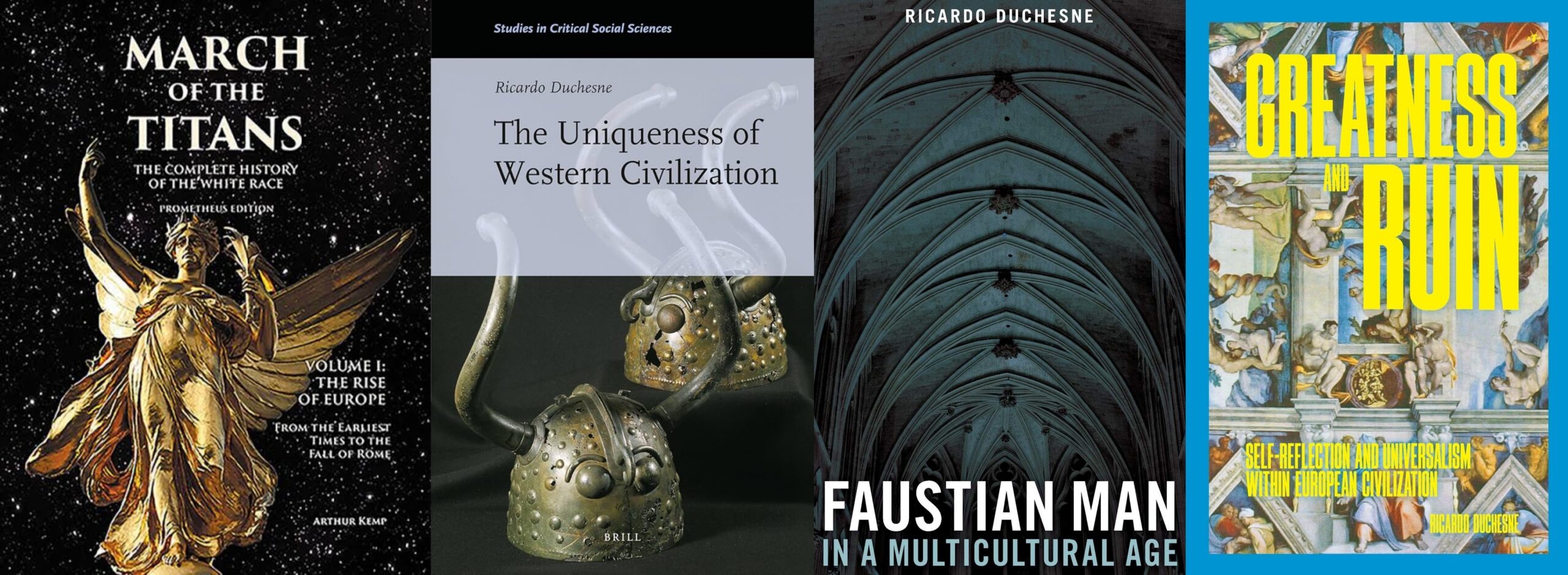
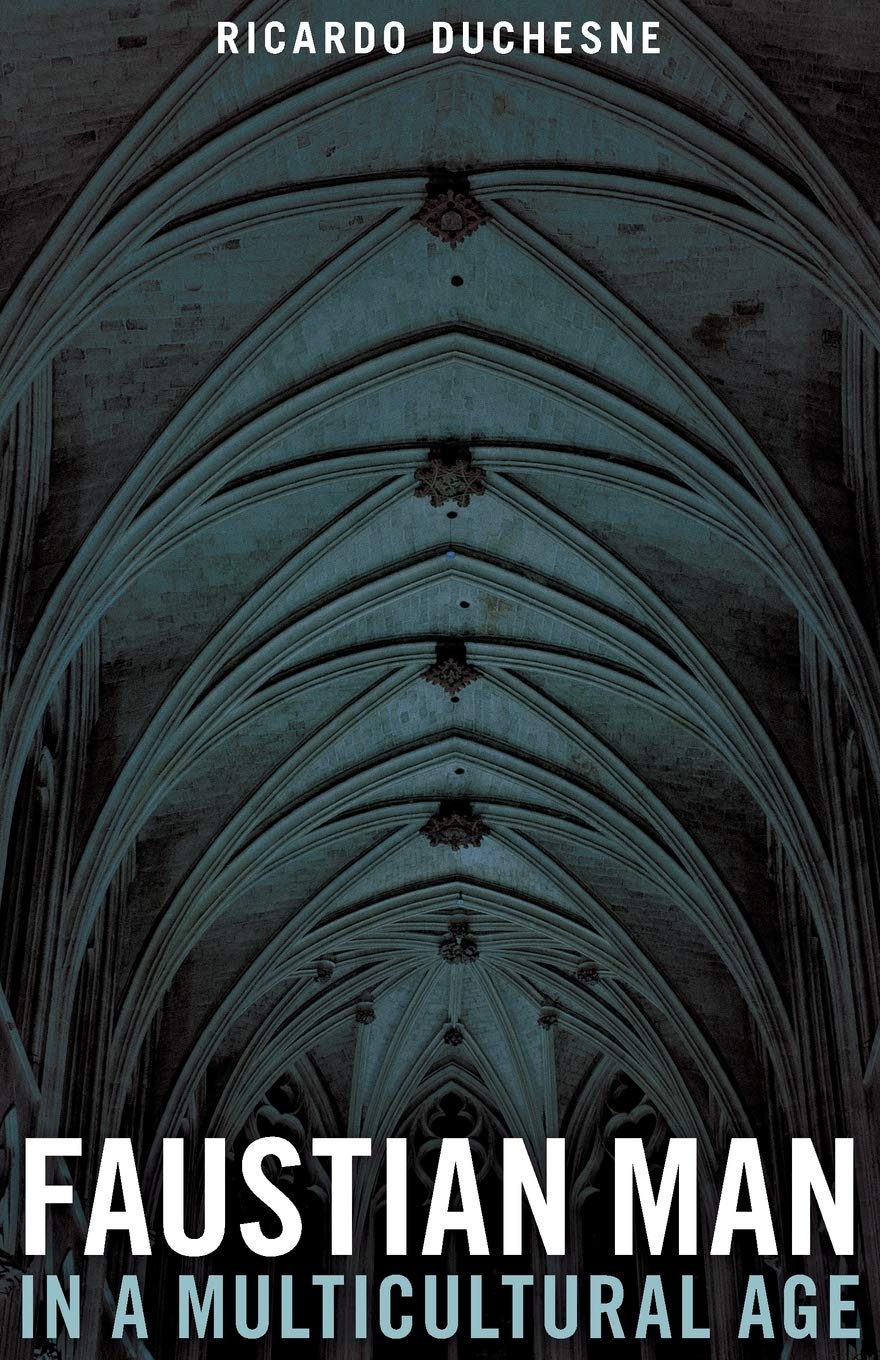
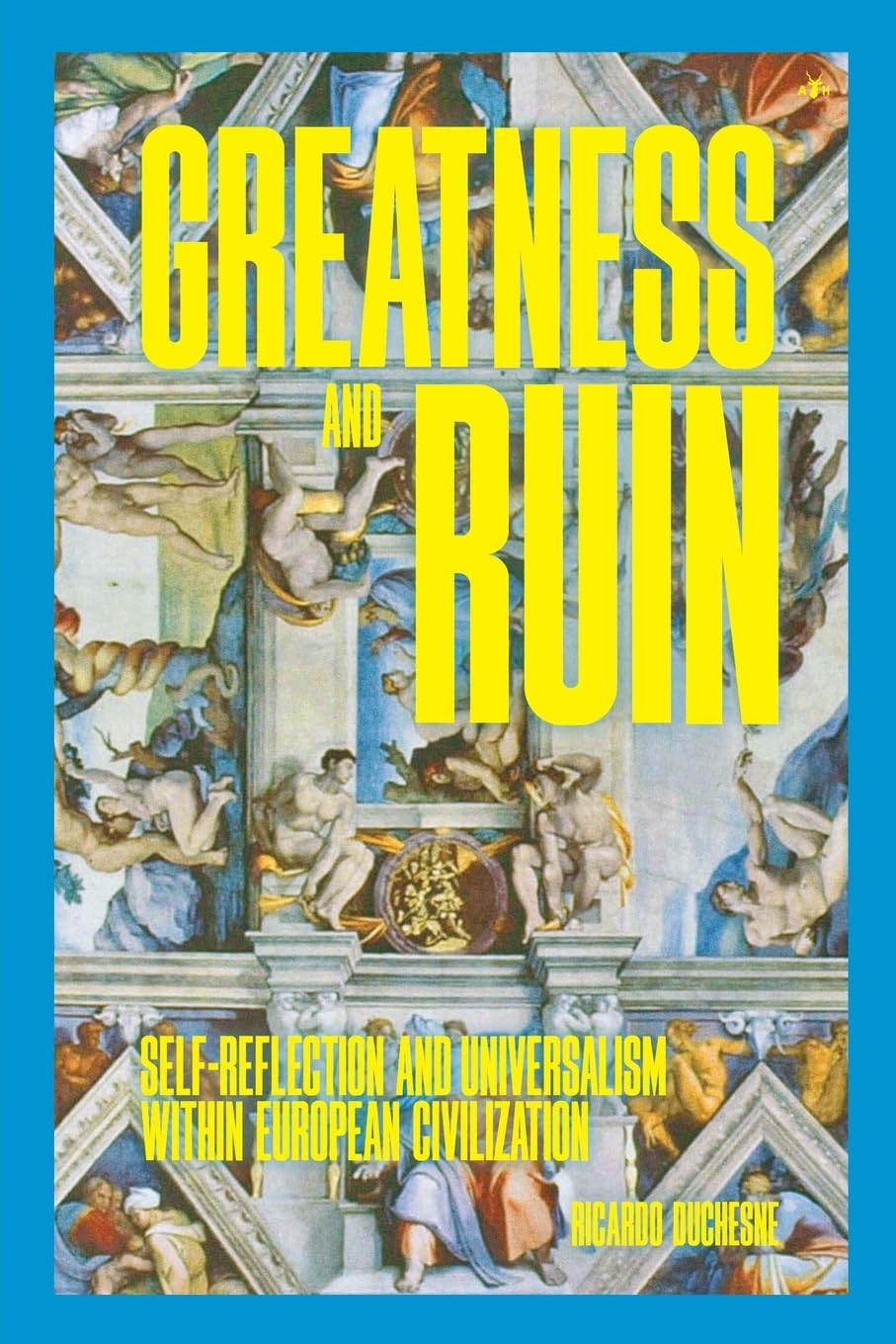
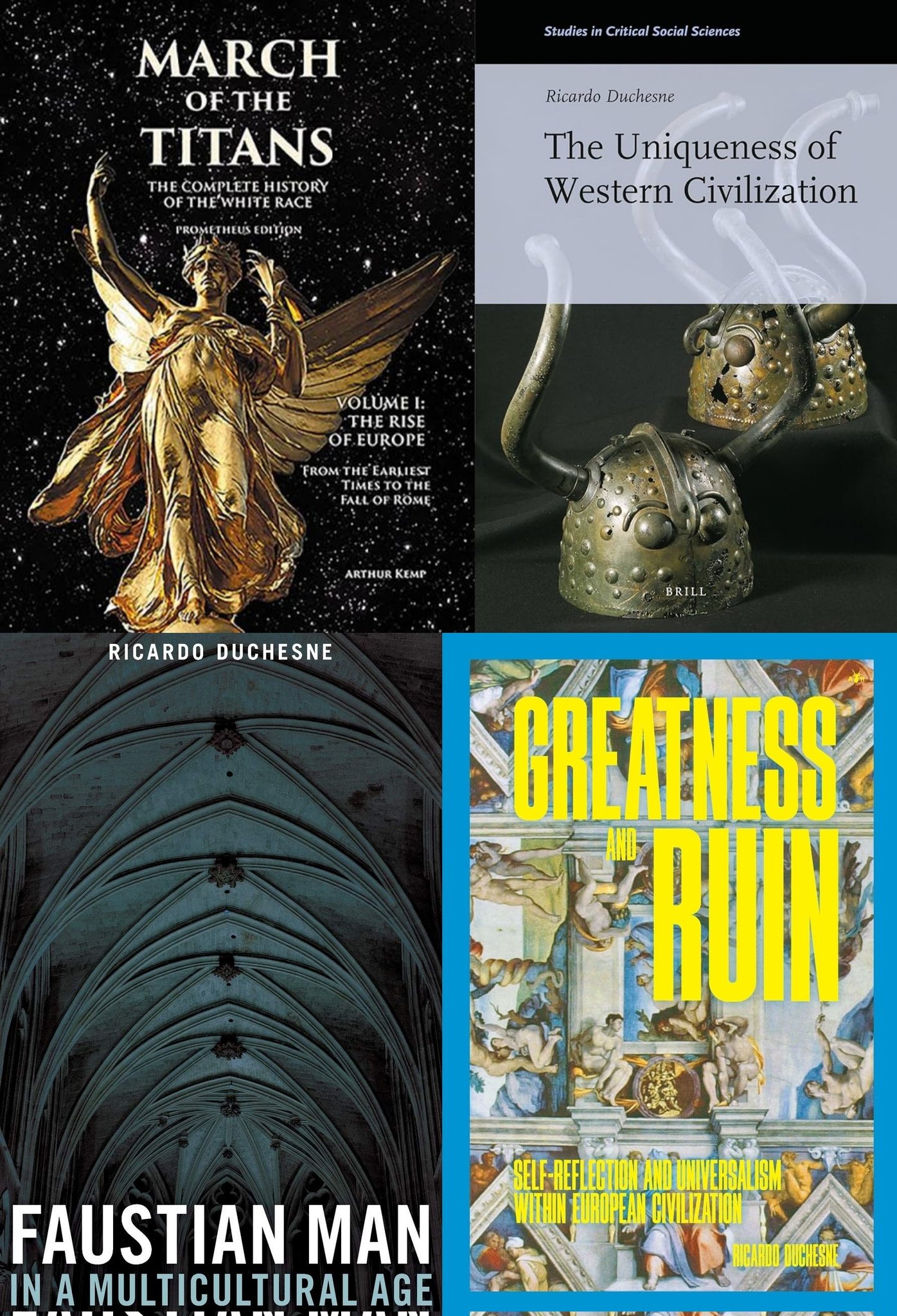
To begin, here are four excellent books to start learning about and being proud of the White race and yourself. These are March of the Titans: The Complete History of the White Race, The Uniqueness of Western Civilization, Faustian Man in a Multicultural Age, and Greatness and Ruin: Self-Reflection and Universalism within European Civilization. These are all detailed below.
Scrolling down you will also learn that ‘Whites have achieved far more in all endeavours of life than all the other races combined; more in Science, Arts, Philosophy, Literature, Empire Making, Freedom, and Truthfulness than all the other cultures combined. Whites are responsible for 97% of everything great in history!’
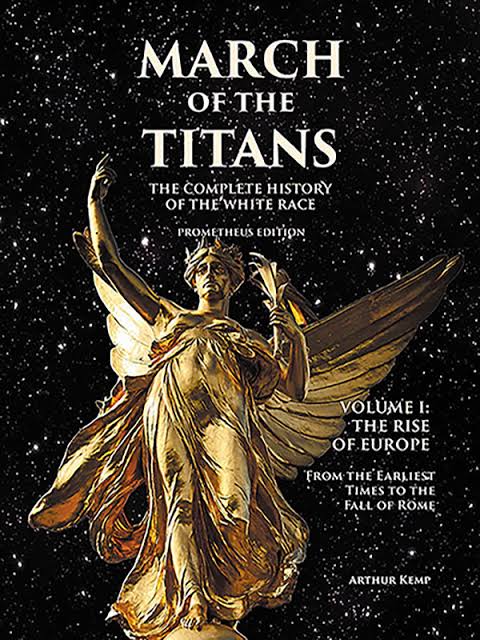
March of the Titans: The Complete History of the White Race (Prometheus Edition) Vol. I-IV (Ostara Publications, 2023-2026 – rewritten, expanded, and updated)
by Arthur Kemp, B.A. (Pol. Sci., Intl. Pol., Pub. Admin)
Vol. III, Part 2: Europe and the World (European Expansion into the New World): COMING SOON
Vol. IV: Europe Against Itself (European Conflicts and the Modern Era): – COMING SOON
The complete history of the white race, spanning 350 centuries of tumultuous events. This is a story–of vast visions, empires, achievements, triumphs, reckless blunders, crushing defeats, and stupendous struggles.
Most importantly, revealed in this work is the one true cause of the rise and fall of the world’s greatest empires – that all civilizations rise and fall according to their racial homogeneity and nothing else–a nation can survive wars, defeats, natural catastrophes, but not racial dissolution.
The Prometheus Edition of March of the Titans has been completely rewritten, expanded, and updated. It is printed in full colour throughout.
Arthur Benjamin Kemp was born of a British father and a Dutch mother in Southern Rhodesia in 1962. Educated in South Africa, he holds a degree in Political Science, International Politics and Public Administration, having studied at the University of Cape Town and the University of South Africa.
He worked as a journalist on a major national daily newspaper; in the South African Police, as an international risk consultant; as a retail market analyst for a blue chip company in the UK; and as a public relations consultant. He has written numerous books, including his famous March of the Titans: The Complete History of the White Race and here (First published 1999, revised, reprinted 2000, 2001, 2002, 2004, 2006, 2008, expanded and updated 2009, 2010, updated 2011, reprinted 2012, 2013. 2014, 2015, 2016, 2017, completely rewritten and updated 2023-2026 (Prometheus Edition)) and owns and operates his publishing company, Ostara Publications which centres on Eurocentric history, politics, and study.
October 27th 2009 (Radio Free Mississippi with Jim Giles and Arthur Kemp) here.
May 16h 2016 (Radio 3Fourteen with Lana Lokteff and Arthur Kemp) here. Transcript here.
September 16th 2020 (Patriotic Weekly Review with Mark Collett and Arthur Kemp) here and here.
March 16th 2021 (Patriotic Weekly Review with Mark Collett and Arthur Kemp) here.
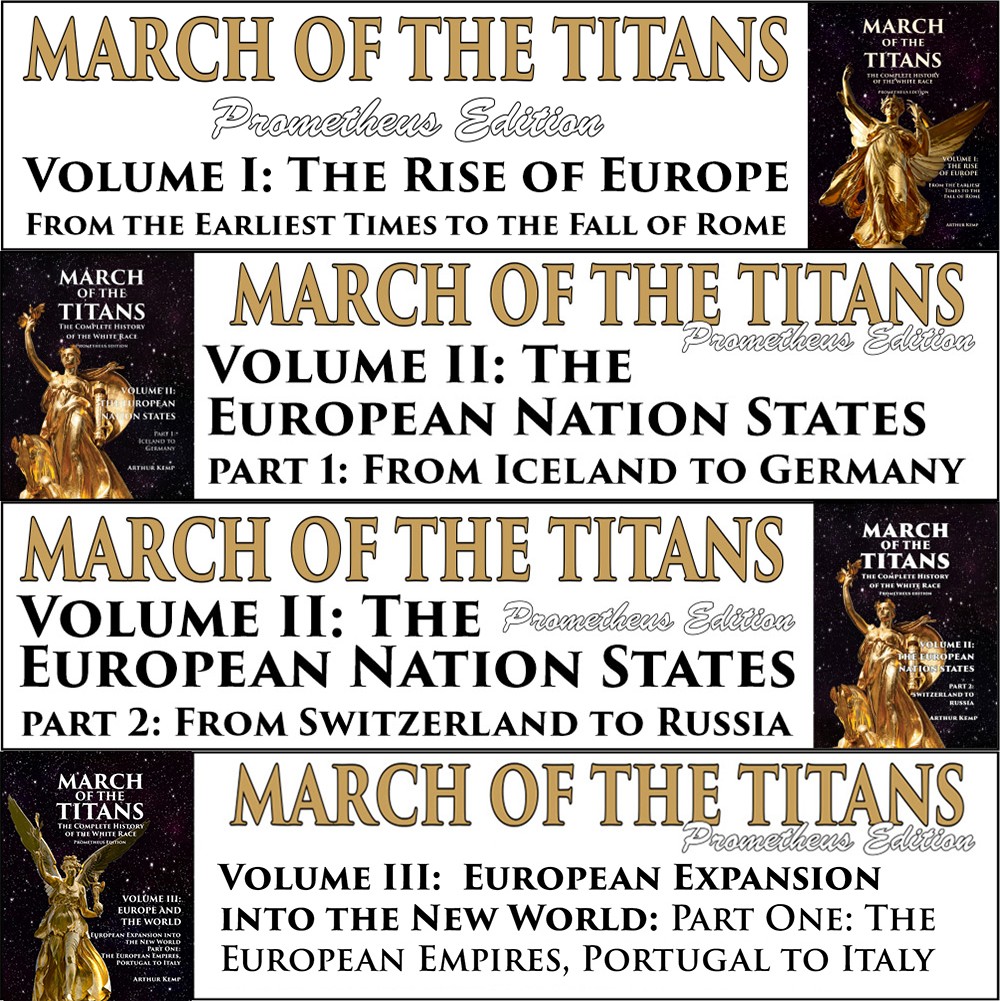
The Uniqueness of Western Civilization
(Brill Academic Publishers, 2011)
by Fmr. Prof. Dr. Ricardo Duchesne, Ph.D.
This extensively researched book argues that the development of a libertarian culture was an indispensable component of the rise of the West. The roots of the West’s superior intellectual and artistic creativity should be traced back to the aristocratic warlike culture of Indo-European speakers.
Among the many fascinating topics discussed are: the ascendancy of multicultural historians and the degradation of European history; China’s ecological endowments and imperial windfalls; military revolutions in Europe 1300-1800; the science and chivalry of Henry the Navigator; Judaism and its contribution to Western rationalism; the cultural richness of Max Weber versus the intellectual poverty of Pomeranz, Wong, Goldstone, Goody, and A.G. Frank; change without progress in the East; Hegel’s Phenomenology of the [Western] Spirit; Nietzsche and the education of the Homeric Greeks; Kojeve’s master-slave dialectic and the Western state of nature; Christian virtues and German aristocratic expansionism. (Purchase)
About the Author
Ricardo Duchesne is a professor at The University of New Brunswick. His landmark book from 2011, The Uniqueness of Western Civilization, was a critique of the ongoing devaluing of Western culture in the face of multiculturalism since the 1960s. He was also the founder and is one of the chief contributors to the Council of European Canadians Website (www.eurocanadian.ca). (Go to author page)
Faustian Man In A Multi-Cultural Age
(Arkros Media, 2017)
by Fmr. Prof. Dr. Ricardo Duchesne, Ph.D.
At this pivotal moment in recent Western history, Richard Duchesne tackles what may be the most crucial question for people of European descent: ‘What makes us unique?’
Casting aside the dominant cultural Marxist narratives and dismissing the popular media attacks on concepts of ‘whiteness’, Duchesne draws on a range of historical examples, sources and philosophies to examine the origins of European man, his achievements, and the nature of the Faustian spirit that has driven his innovation and creativity.
In an age of multiculturalism and globalism one might ask the question ‘Whither Western Man?’ Faustian Man in a Multicultural Age digs deeply in our origins and development to try and point the reader towards the answer. (Purchase)
About the Author
Ricardo Duchesne is a professor at The University of New Brunswick. His landmark book from 2011, The Uniqueness of Western Civilization, was a critique of the ongoing devaluing of Western culture in the face of multiculturalism since the 1960s. He was also the founder and is one of the chief contributors to the Council of European Canadians Website (www.eurocanadian.ca). (Go to author page)
Greatness and Ruin: Self-Reflection and Universalism within European Civilization
(Antelope Hill Publishing, 2025)
by Fmr. Prof. Dr. Ricardo Duchesne, Ph.D.
Of all the noteworthy advances and accomplishments in every area of human endeavor, the overwhelming majority have come from one part of the world: Europe and its New World offshoots, collectively referred to as the West. This troublesome fact may be downplayed or deconstructed by the politically correct establishment, but it cannot be credibly denied. The question, then, is why.
In Greatness and Ruin, maverick scholar Ricardo Duchesne sets out to answer this question, dispelling mainstream academia’s counter-arguments along the way. Demonstrating an extraordinary breadth of scholarship, addressing subjects from music to mathematics, philosophy to furniture design, Duchesne establishes that while other peoples had their share of breakthrough advances at occasions in their histories, the West was the only civilization to produce continuous advancements building upon each other throughout its entire history. He constructs a convincing case that the particular western cultural trait of individualism led to the development of a unique sense of selfhood, producing a culture wherein excellence and ethics are valued more than kinship ties, allowing for a blossoming of creativity and experimentation unparalleled in any other society. This progress has made the West wealthy, industrious, and culturally dominant on a global scale, but also atomized, culturally incoherent, nihilistic, hostile towards its own history, and willing to disrupt its ethnic and racial demographics for short-term economic gain. In short, it has led to our greatness and our ruin. Duchesne argues, however, that the West can retreat from this precipice, tempering the self-destructive, liberal tendency of individualism through historical self-consciousness and a worldview incorporating community and cohesion, while allowing individual creativity to flourish again toward more pro-social ends.
Antelope Hill Publishing is proud to present Ricardo Duchesne’s magnum opus, Greatness and Ruin: Self-Reflection and Universalism within European Civilization, an essential read for anyone fascinated by the historical triumphs of European civilization, the reasons for its degeneration, and what it will take to raise it again.
Below you will find my details about the amazing things Whites have achieved,
“… There would be a respect for the past glories of our civilization… Thinking is the important thing. Being white isn’t enough. Being English isn’t enough. Being British isn’t enough. Know what you are! … to read about your own culture is a revolutionary act. People are taught to rebel at school and hate our high culture, hate our folk culture – it’s all boring… Knowledge is power. Listen to high music, go into the National Gallery… Look at what we’ve produced as a group… I urge all white people in this era to look into the mirror and to ask themselves, “What do you know about what you are?” And if you don’t know enough, put your hand on that mirror, and move towards greater knowledge of what you can become. We’re all going to die. Make use of that time which remains. Greatness is in the mind and in the fist. The glory of our tribe is not behind us. We can be great again. But the first thing that we have to do is to say, “I walk towards the tunnel, and I’m on my own, and I’m not afraid. And I have no regrets.”
“Have you ever wondered why Whites achieved more in Science, Arts, Philosophy, Literature, Empire Making, Freedom, Truthfulness…than ALL the other cultures combined? Get my book Greatness and Ruin (2025). It is selling fast!”
“I explain in my new book, Greatness and Ruin, https://antelopehillpublishing.com/product/greatness-and-ruin-by-ricardo-duchesne/ —– that Whites achieved far more in all the endeavors of life than all the other races combined. Whites contributed about: 97% of ideas in Science 98% of Greatest Explorers 96% of Greatest Philosophers 97% of Greatest Architects 96% of Greatest Painters 95% of Greatest Literary Writers or Novelists 96% of Technological Innovations”
– Fmr. Prof. Dr. Ricardo Duchesne, Ph.D., X, July 28th 2025.
“The West or White civilization was responsible for 97% of human accomplishments in Arts, Sciences, Exploration, and development of all disciplinary fields of knowledge.”
Ricardo Duchesne is a professor at The University of New Brunswick. His landmark book from 2011, The Uniqueness of Western Civilization, was a critique of the ongoing devaluing of Western culture in the face of multiculturalism since the 1960s. He was also the founder and is one of the chief contributors to the Council of European Canadians Website (www.eurocanadian.ca). (Go to author page)
“Do you think there is resentment against Whites because they are responsible for almost everything great? Or do you think many don’t know the following historical facts —- because they are not allowed to read my extensively researched book Greatness and Ruin (2025)?
97% of greatest scientists in history 95% of greatest philosophers 98% of greatest explorers 96% of greatest painters 95% of greatest mathematicians 100% greatest children’s literature/stories 96% of greatest geographers and cartographers 98% of greatest classical composers 97% greatest architects and interior designers 100% responsible for development of all disciplinary fields of knowledge.”
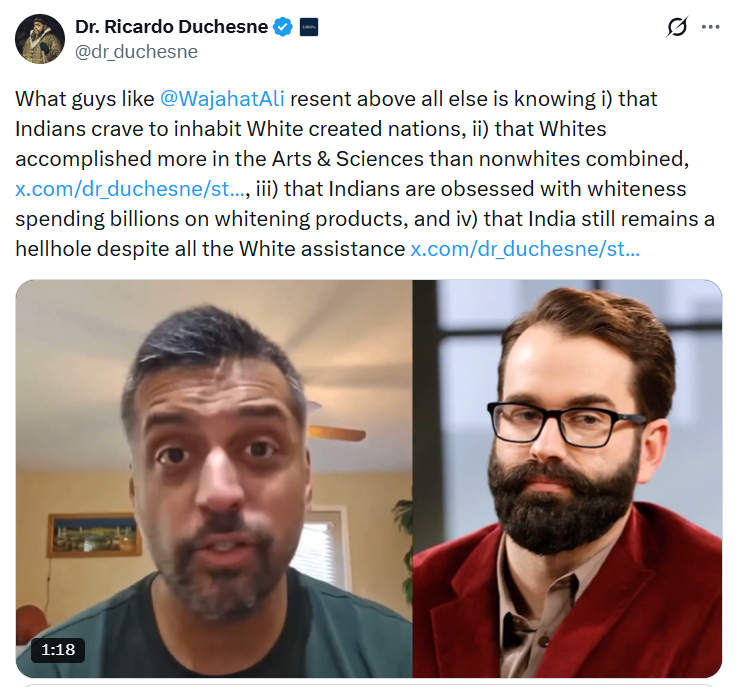
“What guys like @WajahatAli resent above all else is knowing i) that Indians crave to inhabit White created nations, ii) that Whites accomplished more in the Arts & Sciences than nonwhites combined, https://x.com/dr_duchesne/status/1939706428874211838, iii) that Indians are obsessed with whiteness spending billions on whitening products, and iv) that India still remains a hellhole despite all the White assistance https://x.com/dr_duchesne/status/1990795898087981436”
“White European men are responsible for ALL key modern inventions. Amazing. Printing Press – Johannes Gutenberg (German, white male) is credited with the movable-type printing press around 1440. Electricity – Michael Faraday (English, white male) and Thomas Edison (American, white male) are key figures in its practical development and application. Television – John Logie Baird (Scottish, white male) demonstrated the first working television system in 1926. Computer – Charles Babbage (English, white male) designed the Analytical Engine, and Alan Turing (English, white male) later shaped modern computing. Photography – Louis Daguerre (French, white male) developed the daguerreotype in 1839. Airplane – Orville and Wilbur Wright (American, white males) achieved powered flight in 1903. Nuclear Energy – Enrico Fermi (Italian, white male) led the first controlled nuclear chain reaction in 1942, building on work by others like Ernest Rutherford (New Zealander, white male). Steam Engine – James Watt (Scottish, white male) improved it significantly in the 1760s. Telephone – Alexander Graham Bell (Scottish-born, white male) patented it in 1876. Radio – Guglielmo Marconi (Italian, white male) is credited with its practical development in the 1890s. Rocketry – Robert H. Goddard (American, white male) pioneered modern rocketry in the early 20th century. Wernher von Braun (German, white male) later advanced it. Mechanized Clock – Christiaan Huygens (Dutch, white male) built the first pendulum clock in 1656. Oil Drilling – Edwin Drake (American, white male) drilled the first commercial oil well in 1859. Refrigeration – William Cullen (Scottish, white male) demonstrated artificial refrigeration in 1748, with practical systems later refined by Jacob Perkins (American, white male). Pasteurization – Louis Pasteur (French, white male) developed it in the 1860s. Automobile – Karl Benz (German, white male) built the first practical automobile in 1885. Internet – Vinton Cerf and Robert Kahn (Jew) designed TCP/IP protocols in the 1970s, foundational to the internet. Tim Berners-Lee (English, white male) later invented the World Wide Web. Anesthesia – Crawford Long (American, white male) used ether as an anesthetic in 1842. William Morton (American, white male) popularized it. Optical Lenses – Salvino D’Armate (Italian, white male) is often credited with early eyeglasses in the late 13th century. Telegraph – Samuel Morse (American, white male) developed the practical telegraph and Morse code in the 1830s. Semiconductor Electronics – William Shockley, John Bardeen, and Walter Brattain (all American, white males) invented the transistor in 1947 at Bell Labs.”
– Fmr. Prof. Dr. Ricardo Duchesne, Ph.D., X, June 30th 2025.
“Most amazing fact about the comparative study of races is not IQ —- It is that Whites have produced the most fascinating, original literary characters with deep interior monologues, in stark contrast to the scripted, subservience, and lack of individuality of nonwhite characters. 441 BC: Antigone in Sophocles’ Antigone: First proto-inner voice against the polis; chooses death over conformity: “My conscience is higher than your law.” However, Antigone does not yet have a private conscience invented by herself; she dies for the unwritten, eternal laws of blood-family. 397-400 AD: Augustine’s Confessions, where he treats himself as a literary character: First-person autobiography; relentless monologue, self-examination. 1200-1215: Tristan & Isolde in Gottfried von Strassburg’s version: First account of love, courtly love, as a private creation, where the lovers invent an inner moral universe against feudal conventions. 1601: Shakespeare’s Hamlet: seven soliloquies of paralyzing self-analysis: “The time is out of joint — O cursed spite / That ever I was born to set it right!” 1719: Robinson Crusoe by Daniel Defoe: The first sustained first-person monologue in English. The journal section is pure solitary self-examination: fear of damnation, inventory of sins, conversion experience, self-made man on the island. 1749: Clarissa in Samuel Richardson’s Clarissa: 1,500 pages almost entirely in letters; the longest sustained interior monologue before Proust. 1774: Werther in The Sorrows of Young Werther by Goethe: First modern subjective feeling, suicide and the sovereignty of emotion. One of the most intense monologue-novel in literature through a collection of letters from Werther to his friend Wilhelm. The reader is locked inside Werther’s head. “I turn everything back on myself, and find only a world within me.” 1830: Julien Sorel in The Red and the Black by Stendhal: Hypocrisy as self-creation; shoots his lover to preserve the purity of his inner narrative. 1857: Emma Bovary in Madame Bovary by Flaubert: We know through the third person Emma’s inner life more intimately than almost any character before her. The narrator slips in and out of Emma’s mind, her daydreams, disgusts, and desires, without quotation marks. 1866: Raskolnikov in Crime and Punishment by Dostoevsky: 600 pages of a novel inside one murderer’s mind. Streets, rooms, faces, conversations are filtered through his fever, his theories, his guilt. Raskolnikov lives unendurable solitude of being only one who knows his moral crime. 1900: Lord Jim by Joseph Conrad: His entire life is governed by a single moment of cowardice that he endlessly re-interrogates. 1913-1927: Marcel In Search of Lost Time by Proust: 3,000 pages of the most exhaustive self-examination ever found in literature. Everything in Parisian society is filtered through the narrator Marcel, his memory, vanity, snobbery, cowardice, and cruelty. 1934: The Unnamable by Samuel Beckett: The self reduced to pure voice: “I can’t go on, I’ll go on.””
“I don’t say this lightly: German race produced more original minds than the nonwhite world combined!
Invention of the movable-type printing press by Johannes Gutenberg (1440) Johann Joachim Winckelmann, 1717–1768: Pioneer of modern art history and archaeology. Formulation of the laws of planetary motion by Johannes Kepler (1609–1619) Composition of the Brandenburg Concertos by Johann Sebastian Bach (1722) Development of the Critique of Pure Reason by Immanuel Kant (1781) Johann Gottlieb Fichte, 1762–1814, Philosopher foundational to German idealism. Johann Gottfried Herder, 1744–1803, Philosopher and critic who influenced Romanticism and cultural nationalism. Werner von Siemens, 1816–1892, Inventor and industrialist, founder of Siemens company. Alexander von Humboldt, 1769–1859. Explorer and naturalist who advanced geography and ecology. Creation of Faust by Johann Wolfgang von Goethe (1808–1832) Ludwig van Beethoven (1824) One of the top 3 greatest mathematician in Carl Friedrich Gauss (1798) Formulation of dialectical philosophy in Phenomenology of Spirit by Georg Wilhelm Friedrich Hegel (1807). Collection and publication of fairy tales by the Brothers Grimm (1812), preserving folklore and influencing global storytelling. Carl Zeiss, 1816–1888, Optician who founded Zeiss company for precision instruments. Military strategy outlined in On War by Carl von Clausewitz (1832), defining modern warfare theory. Development of non-Euclidean geometry by Bernhard Riemann (1854) Discovery of the cell theory in pathology by Rudolf Virchow (1858) Invention of the telephone prototype by Philipp Reis (1861) Establishment of empirical history methods by Leopold von Ranke (1820s–1880s) Theodor Mommsen, 1817–1903, Historian of ancient Rome, first German Nobel in Literature. Composition of symphonies by Johannes Brahms (1876–1885), epitomizing Romantic music. Invention of the four-stroke engine by Nikolaus Otto (1876). Pioneering human gliding flights by Otto Lilienthal (1891–1896), laying groundwork for aviation. Invention of the diesel engine by Rudolf Diesel (1892). Invention of the automobile by Carl Benz (1885), creating the first practical motor vehicle. Development of the electric dynamo by Werner von Siemens (1866), enabling widespread electrification. Founding of precision optics industry by Carl Zeiss (1846), revolutionizing microscopy and photography. Excavation and discovery of ancient Troy by Heinrich Schliemann (1871–1890), originating archaeology. Composition of the Ring Cycle operas by Richard Wagner (1876). Friedrich Nietzsche (1883–1885) Invention of the zeppelin airship by Ferdinand von Zeppelin (1900), advancing aerial travel. Formulation of quantum theory by Max Planck (1900) Gottlob Frege, 1848–1925, founded modern logic. Writing of The Magic Mountain by Thomas Mann (1924) Authoring Siddhartha by Hermann Hesse (1922) Sociological theory in The Protestant Ethic and the Spirit of Capitalism by Max Weber (1905). Formulation of the uncertainty principle by Werner Heisenberg (1927), key to quantum mechanics. Development of rocket technology (V-2) by Wernher von Braun (1940s), foundational to space exploration. Engraving masterpieces like Melencolia I by Albrecht Dürer (1514), defining Renaissance art. Romantic landscape paintings by Caspar David Friedrich (1810s–1830s), capturing sublime nature. Founding of the Bauhaus school by Walter Gropius (1919), revolutionizing modern design and architecture. Wolfgang Amadeus Mozart (1780s–1790s), defining Classical music perfection. Development of the symphony and string quartet forms by Joseph Haydn (18th century), earning him the title “Father of the Symphony.” Ferdinand Tönnies, 1855–1936, Sociologist who distinguished Gemeinschaft and Gesellschaft. Creation of lieder and symphonies like the Unfinished by Franz Schubert (early 19th century), pioneering Romantic emotional expression. Waltzes like The Blue Danube by Johann Strauss II (1867), embodying Viennese light music and cultural identity. Massive symphonies and choral works by Anton Bruckner (late 19th century), influencing orchestral scale and spirituality. Erwin Schrödinger (1935), co-founder of quantum physics. Max Planck, 1858–1947, co-founder of quantum theory. Development of statistical mechanics by Ludwig Boltzmann (1870s), explaining thermodynamics microscopically. Philosophical calculus and monadology in Monadology by Gottfried Wilhelm Leibniz (1714) Ontology of the Ungrund as the abyssal, groundless non-being at the heart of God and nature by Friedrich Wilhelm Joseph Schelling (1797). David Hilbert, 1862–1943, Mathematician who formulated the 23 unsolved problems. The World as Will and Representation by Arthur Schopenhauer (1818). Being and Time by Martin Heidegger (1927) Development of X-rays by Wilhelm Conrad Röntgen (1895) Organic chemistry advancements by Justus von Liebig (1830s). Electrical resistance law by Georg Ohm (1827), foundational to circuit theory. Temperature scale invention by Daniel Gabriel Fahrenheit (1724), standardizing thermometry. Pioneering ethology and imprinting studies by Konrad Lorenz (1930s–1970s), co-winning a Nobel for animal behavior insights. Carl Gustav Jung, 1875–1961. Oswald Spengler, 1880–1936, Historian and philosopher, author of The Decline of the West. Vienna Secession movement and paintings like The Kiss by Gustav Klimt (early 20th century), defining Art Nouveau. Kurt Gödel, 1906–1978, incompleteness theorems.”
“This is what I call White Privilege: British Men accomplished more than the entire nonwhite world combined!
Formulating the laws of motion and universal gravitation (Isaac Newton). Pioneering the theory of evolution by natural selection (Charles Darwin). Inventing the steam engine (James Watt). Inventing the telephone (Alexander Graham Bell, born in Scotland). Pioneering the jet engine (Frank Whittle). Developing the television (John Logie Baird). Inventing the electric motor (Michael Faraday). Discovering the structure of DNA (Francis Crick). Inventing the reflecting telescope (Isaac Newton). Developing the smallpox vaccine, the world’s first vaccine (Edward Jenner). Pioneering modern nursing during the Crimean War (Florence Nightingale). Inventing the World Wide Web’s foundational technologies (HTML, HTTP by Tim Berners-Lee). Developing radar, crucial in World War II (Robert Watson-Watt). Inventing the tank (Ernest Swinton and others). Discovering hydrogen (Henry Cavendish). Formulating electromagnetic theory (James Clerk Maxwell). Inventing the spinning jenny, revolutionizing textiles (James Hargreaves). Developing the first steam locomotive (George Stephenson). Abolishing the slave trade in the British Empire (William Wilberforce and campaigners). Writing foundational works of English literature (William Shakespeare). Composing iconic classical music (Henry Purcell and Edward Elgar). Pioneering Romantic poetry (William Wordsworth, Lord Byron, Percy Shelley). Writing evolutionary novels like Frankenstein (Mary Shelley). Creating detective fiction (Arthur Conan Doyle’s Sherlock Holmes). Authoring fantasy epics like The Lord of the Rings (J.R.R. Tolkien). Revolutionizing modern music with The Beatles. Leading the abolition of slavery globally through naval enforcement. Establishing parliamentary democracy and the Magna Carta’s legacy. Exploring and mapping Australia (James Cook). Climbing Mount Everest first (Edmund Hillary). Codifying association football (soccer) rules. Puddling process for high-quality wrought iron cheaply iron (Henry Cort). Miners’ safety lamp (Humphry Davy).
Turing machine and foundations of computing and AI (Alan Turing) DNA fingerprinting (Alec Jeffreys) Graphene isolation or super-strong, conductive material. Cat’s eye road reflector (Percy Shaw). Inventing rugby football. Developing cricket into a global sport. Inventing tennis (modern lawn tennis). Pioneering IVF, leading to the first “test-tube baby” (Patrick Steptoe and Robert Edwards). Developing the ATM (automated teller machine) (John Shepherd-Barron). Inventing the World Wide Web (Tim Berners-Lee). Discovering penicillin, the first antibiotic (Alexander Fleming). Developing the first programmable computer concepts (Charles Babbage and Ada Lovelace). Inventing the hovercraft (Christopher Cockerell). Pioneering the Harrier jump jet (VTOL aircraft). Developing the first commercial computer (Ferranti Mark 1, building on British work). Discovering Neptune’s existence mathematically (John Couch Adams). Inventing the light bulb (practical incandescent, Joseph Swan). Developing the pneumatic tyre (John Boyd Dunlop). Inventing carbonated soft drinks (Joseph Priestley). Pioneering photography (William Henry Fox Talbot).”
“They have been deceiving you. The European Middle Ages alone — the “Dark Ages” — produced a higher number of philosophers and scientists than China and India combined.
I. Philosophers: Boethius, 480–524, bridged ancient and medieval thought; his Consolation of Philosophy is still a classic in its exploration of fate, free will, and happiness. John Scotus Erigena, 815–877, combined Neoplatonism with Christian theology; emphasized reason’s role in faith. St. Anselm, 1033–1109, developed the ontological argument for God’s existence; use scholastic/dialectical reasoning to reconcile faith and reason. Peter Abelard, 1079–1142, pioneered conceptualism in the problem of universals; applied logic to theology, famous for his treatise Sic et Non. Peter Lombard, 1100–1160, wrote The Sentences, a systematic theology textbook. Robert Grosseteste, 1175–1253, integrated Aristotelian science with Augustinian illumination; pioneered empirical methods in optics and mathematics. Albert the Great, 1200–1280, synthesised Aristotle and Christianity; classified the sciences and emphasized observation. Roger Bacon, 1214–1292, advocated experimental science and mathematics; criticized reliance on authority. St. Bonaventure, 1221–1274, emphasized illumination and love as paths to knowledge. St. Thomas Aquinas, 1225–1274, harmonized Aristotle with Christian doctrine; innovated the “five ways” proofs for God and natural law ethics in his highly influential book, Summa Theologica. Matthew of Aquasparta, 1237–1302, emphasized direct intuition of individuals, bridged Augustinian and Aristotelian epistemologies. John Duns Scotus, 1266–1308, introduced “haecceity” (thisness) for individuation; defended univocity of being and voluntarism. William of Ockham, 1287–1347, formulated Ockham’s razor for parsimony; advanced nominalism, separating faith from reason. II. Scientists: Gerard of Brussels, early 13th, wrote first text quantifying motion geometrically; used the concept of “uniform difform motion” (constant acceleration). Jordanus de Nemore, 1220–1240, gave correct statics for inclined planes and the concept of “positional gravity”. William Heytesbury, 1335, formalized the mean speed theorem and distinguished kinematics from dynamics. Richard Swineshead, 1340–1355, wrote “extremely detailed” logical analysis of motion, acceleration, and infinite series. Jean Buridan, 1300–1361, provided most developed medieval impetus theory: impetus is proportional to quantity of matter × velocity; it is conserved unless corrupted by resistance or gravity; explained acceleration in free fall as increasing impetus. Albert of Saxony, 1316–1390, popularized Buridan’s impetus theory; applied it to celestial motion (impetus could explain planetary motion without intelligences). Nicole Oresme, 1320–1382, provided graphical representation of velocity-time functions; proved the Mean Speed Theorem geometrically; argued that Earth’s daily rotation is possible; extended impetus to possible perpetual motion in a vacuum.”
“Do you agree that “White men have shaped all that is noble, beautiful, and excellent in history”? Should we rewrite history to be “inclusive” of immigrants even if this video is 100% accurate?”
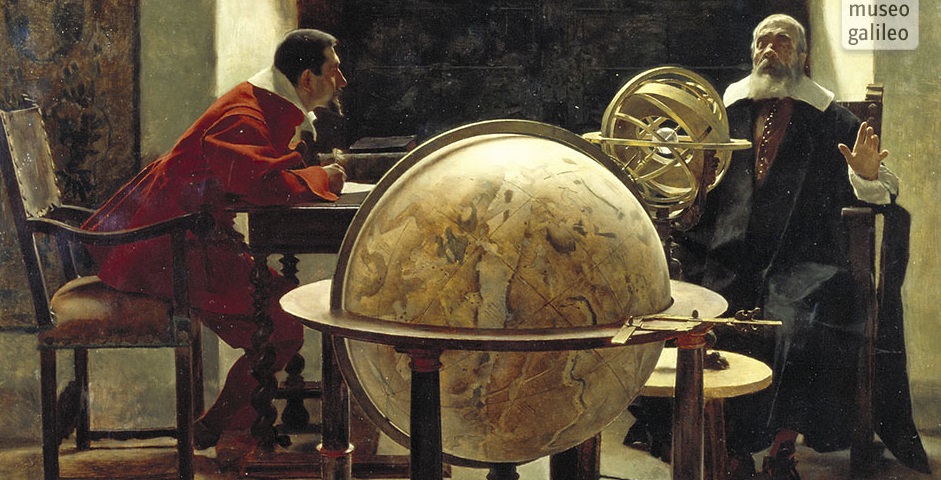
“23 of 25 Greatest Science Books of All Time were written by White men. 1. Physics – Aristotle (4th Century BCE) 2. Almagest – Ptolemy (2nd Century) 3. Ibn al-Haytham – Book of Optics (1011–1021 AD) 4. On the Revolutions of Heavenly Spheres – Nicolaus Copernicus (1543) 5. On the Fabric of the Human Body – Andreas Vesalius (1543). 6. De Re Metallica – Georgius Agricola (1556). 7. On the Magnet – William Gilbert (1600) 8. Harmony of the World – Johannes Kepler (1619) 9. Novum Organum – Francis Bacon (1620) 10. An Anatomical Exercise on the Motion of the Heart and Blood in Living Beings – William Harvey (1628) 11. Dialogue Concerning the Two Chief World Systems – Galileo Galilei (1632) 12. Discourse on the Method – René Descartes (1637) 13. The Sceptical Chymist – Robert Boyle (1661) 15. Micrographia – Robert Hooke (1665) 16. Principia Mathematica – Isaac Newton (1687) 17. Treatise on Light – Christiaan Huygens (1690) 18. Systema Naturae – Carl Linnaeus (1735) 19. Theory of the Earth – James Hutton (1788) 20. Elements of Chemistry – Antoine Lavoisier (1789) 21. On the Origin of Species – Charles Darwin (1859) 22. A Treatise on Electricity and Magnetism – James Clerk Maxwell (1873) 23. Relativity: The Special and the General Theory – Albert Einstein (1916) 24. The Double Helix – James D. Watson (1968) 25. The Insect Societies – Edward O. Wilson (1971) [My list is clearly superior to Discover Magazine’s “25 Greatest Science Books“”
“They say, “Humans have always wanted to understand the universe.” How come, then, nearly 100% of the 25,000–30,000 astronomical objects—planets, exoplanets, stars, and galaxies—with proper names were named by men of European ancestry? This is not surprising, since almost all astronomical discoveries were made by European/American-led missions, telescopes, and superior science. 1. Planets: All 8 major planets have names derived from Roman/Greek mythology, formalized in modern usage by European astronomers. 2. Exoplanets: Over 5,000 confirmed exoplanets exist, of which a few hundred have proper names given by whites. 3. Stars: There are billions of stars, but only a small fraction have proper names (about 530), originated by white men. 4. Galaxies: All famous galaxies (Andromeda, Whirlpool, Sombrero) have descriptive names coined by European astronomers. Millions of galaxies have been cataloged with systematic designations (NGC/IC numbers from 19th-century European compilations).”
The most precious possession you have in the world is your own people. And for this people, and for the sake of this people, we will struggle and fight, and never slacken, never tire, never lose courage, and never lose faith.”
– Adolf Hitler, 5th Reich Party Rally of the NSDAP, Nuremberg, September 1st – 3rd 1933. [You can hear this speech in the Leni Riefenstahl film, Sieg des Glaubens (Victory of Faith) at 30:45. Original German: “Der kostbarste Besitz auf dieser Welt, aber – ist das eigene Volk. Und für dieses Volk – und um dieses Volk, wollen wir Ringen und wollen wir kämpfen. Und Niemals erlahmen; und Niemals ermüden; und Niemals verzagen; und Niemals verzweifeln.” – Adolf Hitler, 5. Reichsparteitag der NSDAP vom 1. bis zum 3. September 1933 in Nürnberg.]
“I can fight only for something that I love. I can love only what I respect. And in order to respect something, I must at least have some knowledge of it.”
– Adolf Hitler, Mein Kampf, Vol. I, Ch. II, Eher Verlag, July 18, 1925. [Source: Dalton translation. p.97, Dual English-German Translation by Prof. Dr. Thomas Dalton, Ph.D., May 3, 2017, Clemens and Blair, LLC, 690 pages. English only translation, p. 70, August 24, 2018. 380 pages.]
 March of the Titans: The Complete History of the White Race (Prometheus Edition)
 About the Author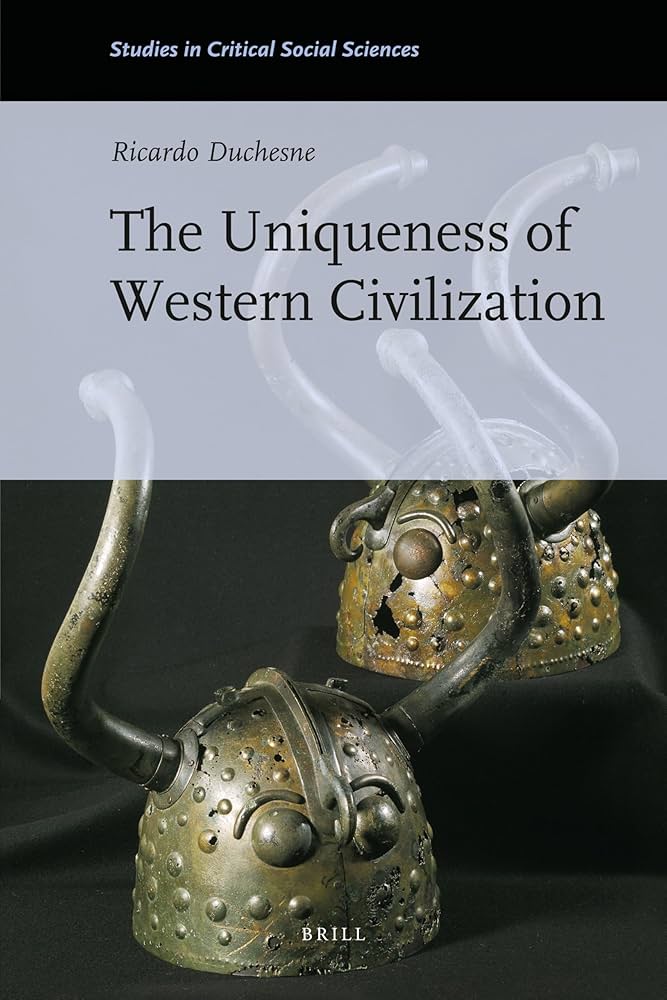
“Do you think there is resentment against Whites because they are responsible for almost everything great? Or do you think many don’t know the following historical facts —- because they are not allowed to read my extensively researched book Greatness and Ruin (2025)?
“What guys like @WajahatAli resent above all else is knowing i) that Indians crave to inhabit White created nations, ii) that Whites accomplished more in the Arts & Sciences than nonwhites combined, https://x.com/dr_duchesne/status/1939706428874211838, iii) that Indians are obsessed with whiteness spending billions on whitening products, and iv) that India still remains a hellhole despite all the White assistance https://x.com/dr_duchesne/status/1990795898087981436”
“White European men are responsible for ALL key modern inventions. Amazing. Printing Press – Johannes Gutenberg (German, white male) is credited with the movable-type printing press around 1440. Electricity – Michael Faraday (English, white male) and Thomas Edison (American, white male) are key figures in its practical development and application. Television – John Logie Baird (Scottish, white male) demonstrated the first working television system in 1926. Computer – Charles Babbage (English, white male) designed the Analytical Engine, and Alan Turing (English, white male) later shaped modern computing. Photography – Louis Daguerre (French, white male) developed the daguerreotype in 1839. Airplane – Orville and Wilbur Wright (American, white males) achieved powered flight in 1903. Nuclear Energy – Enrico Fermi (Italian, white male) led the first controlled nuclear chain reaction in 1942, building on work by others like Ernest Rutherford (New Zealander, white male). Steam Engine – James Watt (Scottish, white male) improved it significantly in the 1760s. Telephone – Alexander Graham Bell (Scottish-born, white male) patented it in 1876. Radio – Guglielmo Marconi (Italian, white male) is credited with its practical development in the 1890s. Rocketry – Robert H. Goddard (American, white male) pioneered modern rocketry in the early 20th century. Wernher von Braun (German, white male) later advanced it. Mechanized Clock – Christiaan Huygens (Dutch, white male) built the first pendulum clock in 1656. Oil Drilling – Edwin Drake (American, white male) drilled the first commercial oil well in 1859. Refrigeration – William Cullen (Scottish, white male) demonstrated artificial refrigeration in 1748, with practical systems later refined by Jacob Perkins (American, white male). Pasteurization – Louis Pasteur (French, white male) developed it in the 1860s. Automobile – Karl Benz (German, white male) built the first practical automobile in 1885. Internet – Vinton Cerf and Robert Kahn (Jew) designed TCP/IP protocols in the 1970s, foundational to the internet. Tim Berners-Lee (English, white male) later invented the World Wide Web. Anesthesia – Crawford Long (American, white male) used ether as an anesthetic in 1842. William Morton (American, white male) popularized it. Optical Lenses – Salvino D’Armate (Italian, white male) is often credited with early eyeglasses in the late 13th century. Telegraph – Samuel Morse (American, white male) developed the practical telegraph and Morse code in the 1830s. Semiconductor Electronics – William Shockley, John Bardeen, and Walter Brattain (all American, white males) invented the transistor in 1947 at Bell Labs.”
“Most amazing fact about the comparative study of races is not IQ —- It is that Whites have produced the most fascinating, original literary characters with deep interior monologues, in stark contrast to the scripted, subservience, and lack of individuality of nonwhite characters. 441 BC: Antigone in Sophocles’ Antigone: First proto-inner voice against the polis; chooses death over conformity: “My conscience is higher than your law.” However, Antigone does not yet have a private conscience invented by herself; she dies for the unwritten, eternal laws of blood-family. 397-400 AD: Augustine’s Confessions, where he treats himself as a literary character: First-person autobiography; relentless monologue, self-examination. 1200-1215: Tristan & Isolde in Gottfried von Strassburg’s version: First account of love, courtly love, as a private creation, where the lovers invent an inner moral universe against feudal conventions. 1601: Shakespeare’s Hamlet: seven soliloquies of paralyzing self-analysis: “The time is out of joint — O cursed spite / That ever I was born to set it right!” 1719: Robinson Crusoe by Daniel Defoe: The first sustained first-person monologue in English. The journal section is pure solitary self-examination: fear of damnation, inventory of sins, conversion experience, self-made man on the island. 1749: Clarissa in Samuel Richardson’s Clarissa: 1,500 pages almost entirely in letters; the longest sustained interior monologue before Proust. 1774: Werther in The Sorrows of Young Werther by Goethe: First modern subjective feeling, suicide and the sovereignty of emotion. One of the most intense monologue-novel in literature through a collection of letters from Werther to his friend Wilhelm. The reader is locked inside Werther’s head. “I turn everything back on myself, and find only a world within me.” 1830: Julien Sorel in The Red and the Black by Stendhal: Hypocrisy as self-creation; shoots his lover to preserve the purity of his inner narrative. 1857: Emma Bovary in Madame Bovary by Flaubert: We know through the third person Emma’s inner life more intimately than almost any character before her. The narrator slips in and out of Emma’s mind, her daydreams, disgusts, and desires, without quotation marks. 1866: Raskolnikov in Crime and Punishment by Dostoevsky: 600 pages of a novel inside one murderer’s mind. Streets, rooms, faces, conversations are filtered through his fever, his theories, his guilt. Raskolnikov lives unendurable solitude of being only one who knows his moral crime. 1900: Lord Jim by Joseph Conrad: His entire life is governed by a single moment of cowardice that he endlessly re-interrogates. 1913-1927: Marcel In Search of Lost Time by Proust: 3,000 pages of the most exhaustive self-examination ever found in literature. Everything in Parisian society is filtered through the narrator Marcel, his memory, vanity, snobbery, cowardice, and cruelty. 1934: The Unnamable by Samuel Beckett: The self reduced to pure voice: “I can’t go on, I’ll go on.””
“I don’t say this lightly: German race produced more original minds than the nonwhite world combined!
“This is what I call White Privilege: British Men accomplished more than the entire nonwhite world combined!
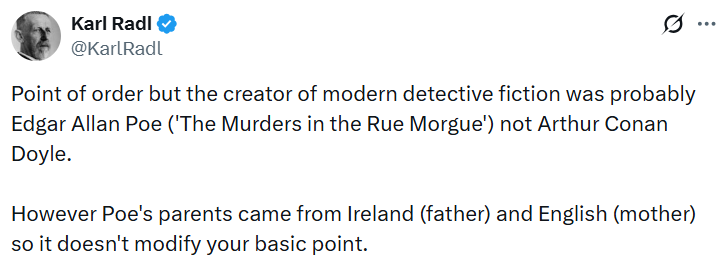
“They have been deceiving you. The European Middle Ages alone — the “Dark Ages” — produced a higher number of philosophers and scientists than China and India combined.
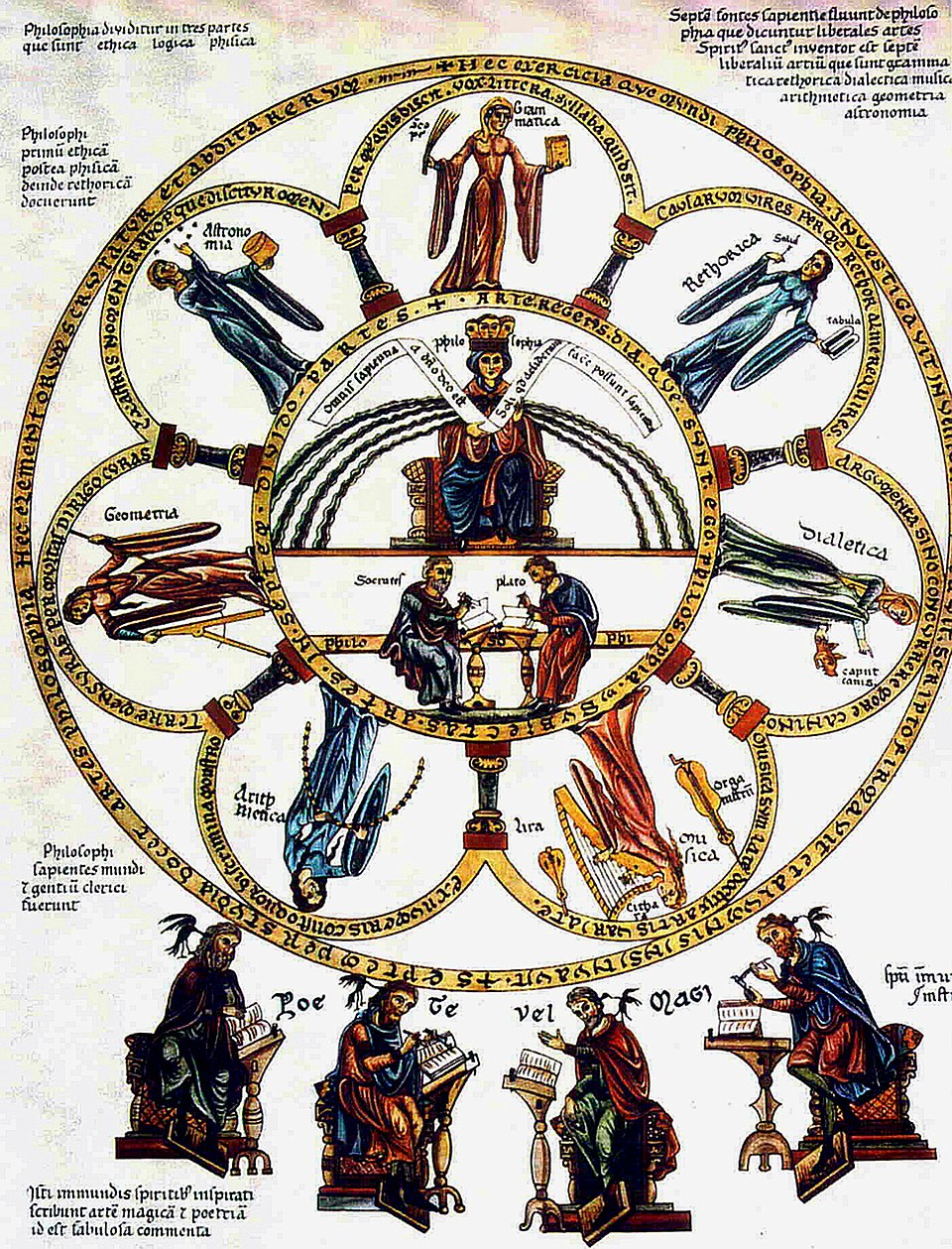
“23 of 25 Greatest Science Books of All Time were written by White men. 1. Physics – Aristotle (4th Century BCE) 2. Almagest – Ptolemy (2nd Century) 3. Ibn al-Haytham – Book of Optics (1011–1021 AD) 4. On the Revolutions of Heavenly Spheres – Nicolaus Copernicus (1543) 5. On the Fabric of the Human Body – Andreas Vesalius (1543). 6. De Re Metallica – Georgius Agricola (1556). 7. On the Magnet – William Gilbert (1600) 8. Harmony of the World – Johannes Kepler (1619) 9. Novum Organum – Francis Bacon (1620) 10. An Anatomical Exercise on the Motion of the Heart and Blood in Living Beings – William Harvey (1628) 11. Dialogue Concerning the Two Chief World Systems – Galileo Galilei (1632) 12. Discourse on the Method – René Descartes (1637) 13. The Sceptical Chymist – Robert Boyle (1661) 15. Micrographia – Robert Hooke (1665) 16. Principia Mathematica – Isaac Newton (1687) 17. Treatise on Light – Christiaan Huygens (1690) 18. Systema Naturae – Carl Linnaeus (1735) 19. Theory of the Earth – James Hutton (1788) 20. Elements of Chemistry – Antoine Lavoisier (1789) 21. On the Origin of Species – Charles Darwin (1859) 22. A Treatise on Electricity and Magnetism – James Clerk Maxwell (1873) 23. Relativity: The Special and the General Theory – Albert Einstein (1916) 24. The Double Helix – James D. Watson (1968) 25. The Insect Societies – Edward O. Wilson (1971) [My list is clearly superior to Discover Magazine’s “25 Greatest Science Books“”